I had to share this wonderful Shaklee success story, success in a suprising way. Would something like this be in your future? Or the future of someone you know? To begin, use the products to change your health. Then you’ll be ready to change your financial picture and the health of many.
Barbara reports: As a single, full time RVer on limitedSocial Security I needed energy and focus, not only for driving, but for workamping temporary ‘jobs’ (i.e. will work for camping fees) which can be quite demanding. I will describe some of my exciting experiences, including a job I took on as a challenge to myself, wondering if I could do it at my age, my joy and ideas about my success, and how Shaklee helped me achieve my energy needs.
I have been using Shaklee products since January 1980. During the economic downturn in the mid 90s AT&T laid off 10,000 people locally in five days, and I lost ½ of my therapy practice, and ½ of my income that week! Quite a shock!
While taking my supplements one morning and mulling over what to do, I realized “I’m sitting with a business opportunity right here in my lap!” I knew the products, the philosophy of the company, the quality, etc. My uplines had been including business profiles sometimes in my orders (nothing was on line yet) and I had read all of them. I called and asked if they thought I could build a business; they encouraged and helped me! I built a nice business in NJ, till it equaled my agency pay; and then moved to Las Cruces, NM … keeping the remainder of my private practice going by phone. By the time I retired from counseling, I had enjoyed bonus travel the Shaklee way, and built my business to nicely cover my expenses, which gave me the freedom to travel full time and fulfill my dreams! What an adventure, Thanks to Shaklee!
To check out my business leadership and what the Shaklee business could look like go to www.HiHoWealth.com
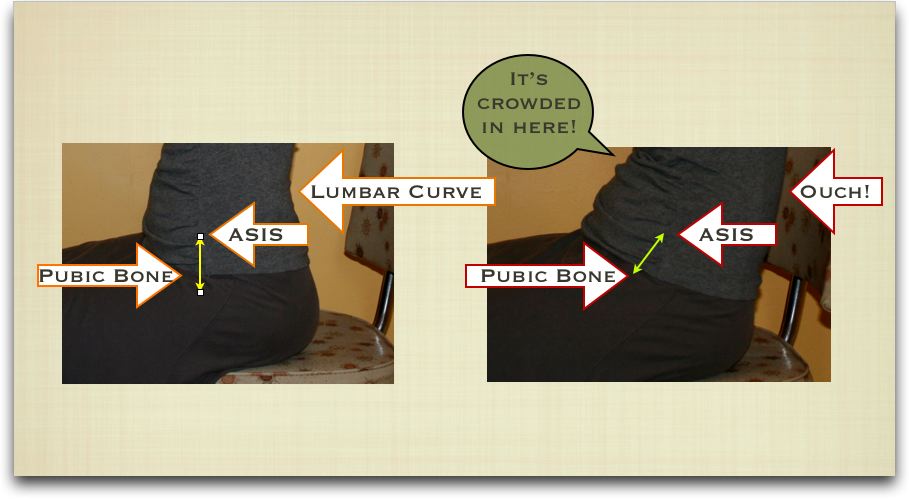
Sitting causes premature death. Wow, that’s a big statement. Imagine my surprise when an NRP report on the radio last week suggested that sitting will be the next “smoking” as a cause of early death. I have harped ad nauseum about the need to keep moving, but I didn’t think it would come to this.
“Sitting is more dangerous than smoking, kills more people than HIV and is more treacherous than parachuting. We are sitting ourselves to death.” Dr. James Levine, director of the Mayo Clinic-Arizona State University Obesity Solutions Initiative and inventor of the treadmill desk. Read more.
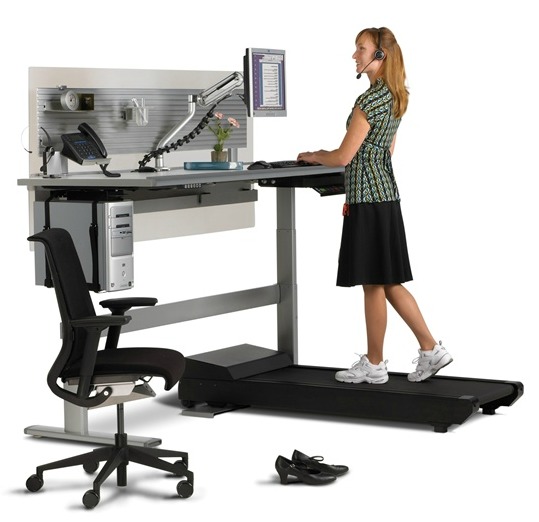
a work station that helps you keep moving.
A study conducted as part of the Women’s Health Initiative titled Sedentary Behavior and Mortality in Older Women concluded that the women with the highest rate of sedentary life had a 95% increase in death by all causes than the women with the lowest rate of sitting. The study was conducted with over 92,000 women aged 50 – 79; body mass, age, ethnicity, physical function, physical activity and chronic disease were taken into consideration. They wanted to know if there is a correlation between a sedentary life style and diseases of cancer, cardiovascular and coronary heart disease. Sure enough, there is. What we all intuited is a sure thing: you lose it if you don’t use it. Keep moving!
In the radio report, the final word was “the next position is the best position,” i.e. move.
A similar study was conducted by Kaiser Permanente with over 85,000 men aged 45. The research covered 10 years of self-reporting for activity outside of work. Men with the lowest level of physical activity were more than twice as likely to develop heart failure than those in the most active group (7.8 heart failure cases per 1,000 person years compared with 3.8 cases). The men who spent the most time sitting were also more than twice as likely to develop heart failure than those who sat the least (8.8 heart failure cases per 1,000 person years compared with 3.8 cases).
For a lot of us this is bad news. We sit at our work, sometimes for hours at a stretch. I sit for hours in front of my computer. My “to-do” list everyday includes multiple tasks that require sitting at my desk. Many of us have office jobs where we are chained to our desks. Even work that requires moving around a fair amount includes several long stretches sitting at the computer.
In the study involving men, it didn’t matter what they did for work. Only their activity outside of work was considered. Apparently a man who moves all day at work but sits all evening and on the weekends, is not protected by his physical activity on the job. I find this “outside of work” fact to be particularly interesting. KUOW reported on this study in January of last year.
What happens to the body when we sit for long periods of time? The effects are scary.
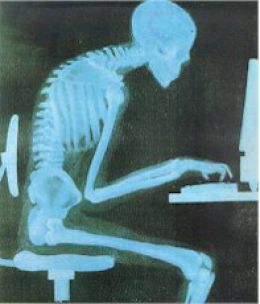
sitting is killing us
Muscle atrophy. Mushy abs; tight hips; limp gluts. You have to work your muscles to keep them.
Organ damage. Heart, pancreas and colon begin to malfunction.
Foggy brain. Slow circulation and a bent neck cause poor brain function.
Soft bones and bad back. Joint health in general deteriorates when there is prolonged sitting. Avoiding osteoporosis requires weight bearing movement.
Type II Diabetes risk increase It takes movement to get insulin into cells and control blood sugar
Cancer risk increase Colon, endometrial and possibly lung cancers in particular
Obesity increase even without an exercise program, simply moving more throughout the day keeps fat away
Depression risk seven hours of sitting a day greatly increases depression
Benefits of moving are legion. My daughter Priscilla, personal trainer and group exercise specialist, is a strong proponent of the benefit of aerating your body. She believes that a half hour of vigorous exercise a day will flush the impurities from your blood and carry away bacteria, viruses and other unwanted invaders from your system. When your circulation slows down, blood pools, clots could form.
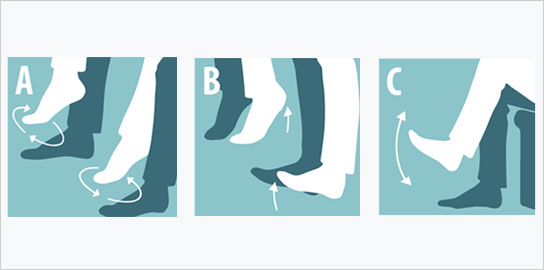
airplane exercises
Sitting on an airplane is one of the worse things you can do to your circulation. For those of us who love to travel, the 9 – 12 hour flights can be deadly. For those who have to fly for work, here are some tips to keep moving in the air. Flex your calves. “Your calves are often called your second heart because of the role they play in helping pump venous blood from the lower extremities,” says Leslie Kaminoff, a yoga therapist and breathing specialist in New York. Something as simple as tapping the feet will also create movement in the shins and thighs, and even in the hip joint. Drink a lot of water because it will force you to get up and head for the lavatory.
I find that when I get up from a prolonged seated position, I have more pain and stiffness in my joints. I have noticed that if I can make myself take a short walk, the pain eases. In college I used to walk around the dorm reading, mostly to stay awake, but, I now realize, I needed to move then, too.
Working at home as many people do nowadays, you have to create a schedule for moving. I use a timer to remind me to get up. I might garden for 20 minutes; fold laundry; check on the chickens. The biggest problem with interrupting yourself as an at-home worker, is getting back to the desk. You could look at the clock and realize you’ve been in the garden for two hours. It requires vigilance and discipline to take a break, move, and get back to work.
sit to aid digestion
Digestion issues from sitting too long, the pancreas and colon sluggishness, can be corrected so easily. Just a short walk will get things moving. I have a friend who takes a walk with her husband nearly every night after dinner. She’s the lovely person who introduced me to Shaklee and a whole new way of life back in 1985.
This article gives suggestions for moving: sit on a ball, walk around during commercials, get out of your chair and stretch the hip flexors every hour or so, get a standing work station (I found several references to using a treadmill desk) and do the cat/cow yoga exercise several times a day. Some of these are easier than others in an office setting.
Imagine what would happen if the Surgeon General of the US decreed that movement is a health necessity, not just a health benefit.
Sitting is often a relief, a relished pleasure when you are worn out from cooking, shopping, cleaning house, wrapping packages, wandering through an art gallery and you just can’t wait to sit down. I love that instant comfort that comes from collapsing into a chair or sofa. Fine. Enjoy. Just don’t let 4 – 5 hours go by in that sitting position before you get up and move again.
All the best for this holiday season. Get out and take a walk, snow shoe, ski, shoot baskets with your kids and grandkids, dance. I’ve just started attending my oldest daughter, Grace and Jon, her husband’s Free Form Dance Dance on Saturday mornings. What a joy to move my body to great music for about 80 minutes in a big room with a wall of glass looking out into trees, and a group of people all joyously moving according to their inner guide!
Chronic disabilities won’t hold you back. Get out and explore the world. If by my bravado in the face of aches and pains irritates you, my intention is not to belittle, but to inspire. This story inspires me. It may seem as though I am never down, but leap about all the time. I do get grumpy when everything hurts and I will do anything to sit down for a few minutes to rest my back, hips and knees. So, I’m with you if you are one of the people caught up short by arthritis.
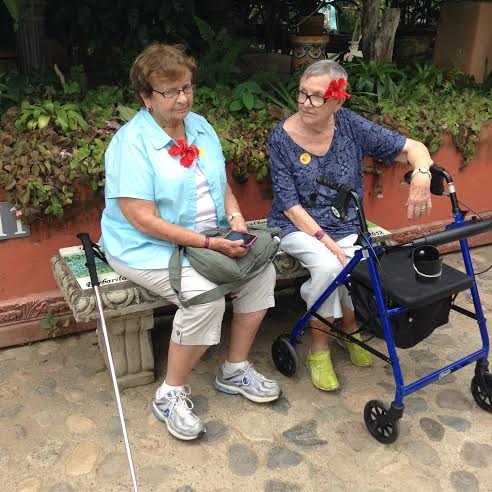
Jaon and Polly at the Botanical Gardens
I just spent twelve days in Mexico with three companions, two of whom use support for walking: a walker and a hiking stick. All three are several years older than I which puts two of them in their 80s. I worried when I invited them to accompany me to my lavish time-share in Nuevo Vallarta because the walking distance from the unit to the pool is quite far. There are steps involved. Any trips into Puerto Vallarta and beyond would have uneven pavements and sketchy handicap access. Only in the USA is there a preoccupation for the welfare of a handicapped person.
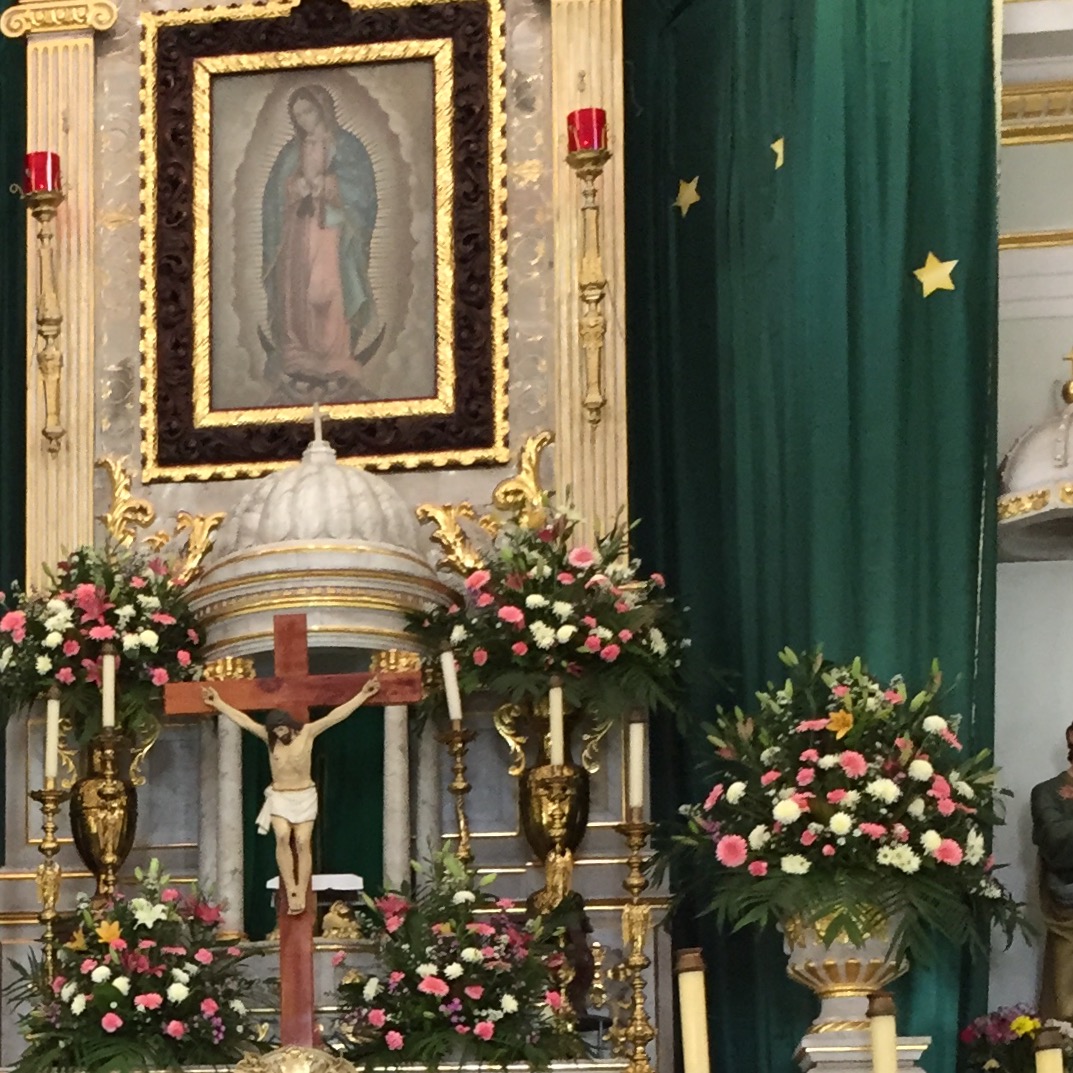
So imagine my relief and my delight when these gals said, “Yes” to every adventure, walked the vast campus of the Gran Mayan complex, took a public bus home from the Puerto Vallarta Arboretum way south of town and climbed the steep ramp to worship at the great church of the Virgin of Guadalupe in downtown PV.
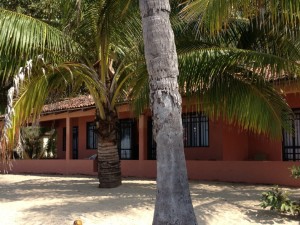
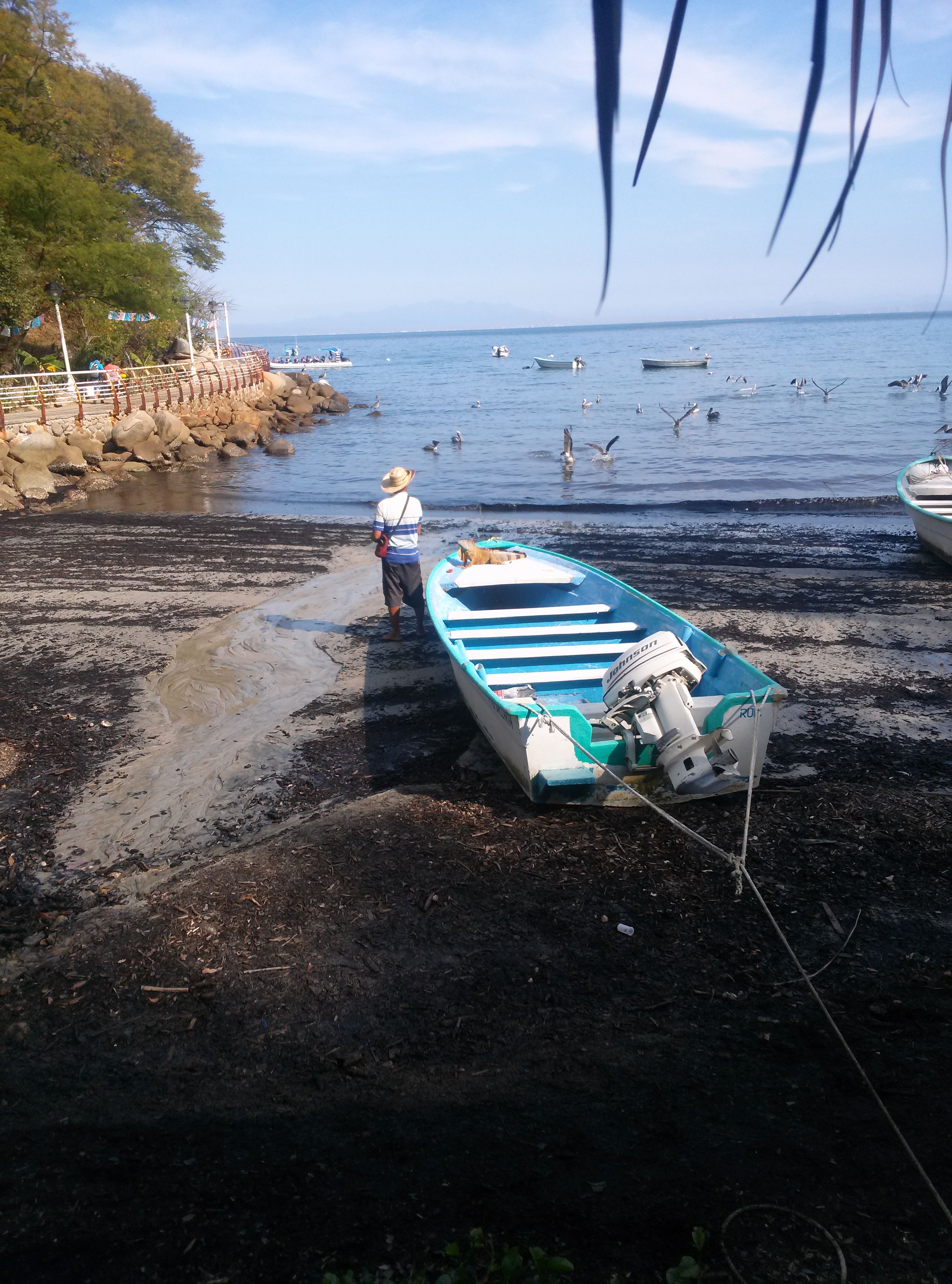
Waiting for the taxi in Boca de TomatlanFor five days before the four of us met at my time-share, my sister-in-law and I vacationed at a beach cottage at the far south end of Bandera Bay. She found it on Vacation Rental by Owner (http://www.vrbo.com/465074), La Casa de las Olas. To get there you have to take a taxi from the Puerto Vallarta airport all the way through the city which lies in the center of the Bay, to the town of Boca de Tomatlan. At this village, the coastal highway 200 turns up into the jungle covered mountains touching the Pacific again just northwest of Manzanillo. In Boca, we were supposed to meet Raul Ramos, a fisherman with an open panga, a high-powered motor and the keys to La Casa, our destination on a beach several coves along the coast. Because my s-in-l’s plane was 5 hours late and because neither of us had cell phone or internet coverage, we had no way to telling Raul we would be very late. Undaunted, we set out at 10 p.m. for Boca, routed out a guy drinking beers in the beach restaurant where we were supposed to rendezvous and asked him to help us find Raul. He knocked on the door of a boat owning Raul who appeared toothbrush in hand, wearing boxer shorts and responding, “I’ve got a boat. Let me put on a shirt and I’ll take you to Quimixto.” “Fine,” I answered him in Spanish, “but you don’t have the keys nor do you know which house it is.” Our taxi driver, wild with worry at what I would try next, begged us to let him take us away from this little town with no hotel and go back to civilization where he could put us down in safety (and go home to tell his wife and neighbors about these two crazy old ladies who insisted on climbing into a boat at midnight). We found a Best Western along the way and set out again the next morning, this time with charged cell phones and phone numbers. We were happily in the hands of Raul before noon who settled us into our fabulous beach cottage. Getting into his boat in Boca and out again in Quimixto required wading in the surf and climbing in. My s-in-l was guided onto the gunwales and Raul lifted her stick in and then each leg; then hefted our large suitcases into the open motor boat. On the beach in Quimixto, we had to reverse the process, tottering on Raul’s arm from the surf up the beach to our cottage. That was courageous of my s-in-law. She made it with fierce determination.
Casa Pelicanos/465074
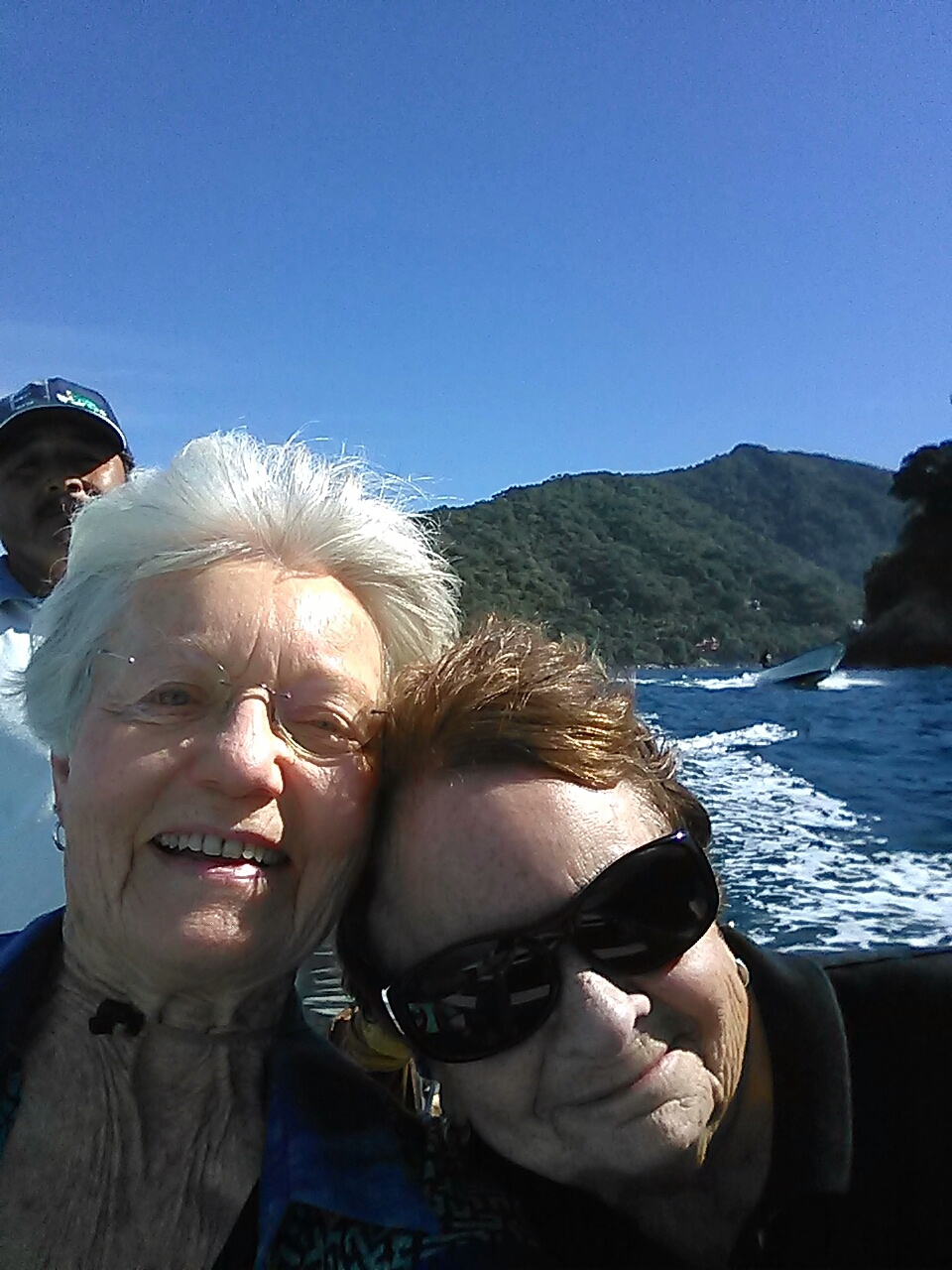
A fine boat ride to Quimixto.
Once we were settled and had a look around, we were smitten by the place: an unbroken view of the ocean, waves crashing just beyond the low wall; majestic native trees rising out of pale blond sand; pelicans swooping along the wave crests; the occasional horsed rider passing by on the beach. Raul’s wife brought us a fabulous dinner of fresh mahi mahi and homemade tortillas. I made fresh lime margaritas and guacamole from the groceries I had bought in the Mega Comerciante while waiting for my s-in-l to arrive. The kitchen was a dream to cook in with its gas stove, big counter and all the condiments you could ask for plus every insect repellant you could imagine. I did get a few sand flea bites, but no mosquitoes. The air was fresh, the stars brilliant after the full moon set. The hammock perfectly located on the veranda. We each had our own bedroom and bath, not luxurious, but homey and comfortable.
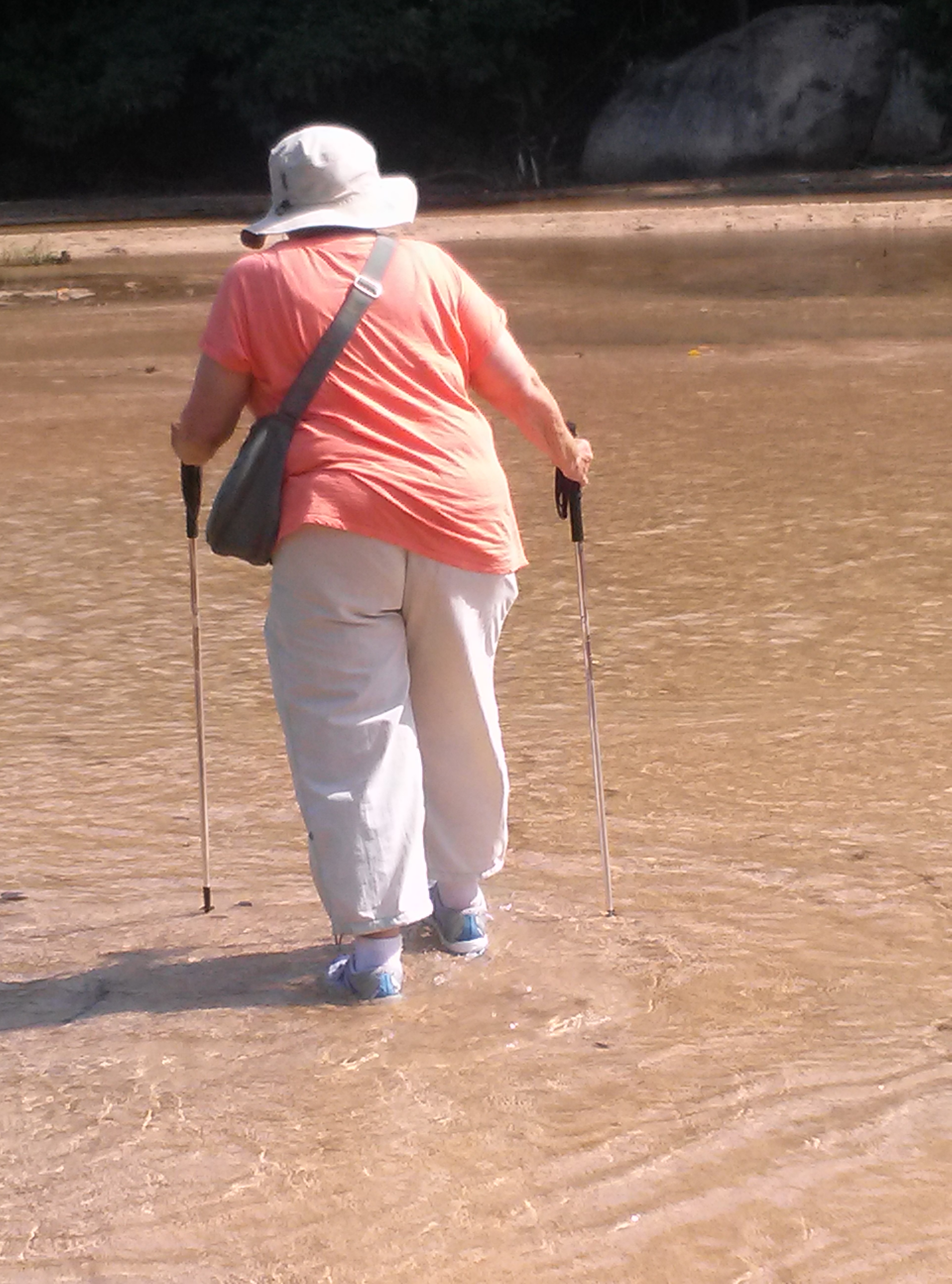
The next day we decided to see the village of Quimixto knowing there was a stream to cross. The “steam” turned out to be a wide river, slow moving and shallow, thank goodness. My s-in-l used her sticks and her water shoes.
wading the stream in QuimixtoAlternative route across the river
I put on my tevas and replaced them with walking shoes on the other side. The village is about five cobble stone paved blocks along with a pier at the far end and a few shops, an open church and a primary school plus private houses along the way. The little harbor is full of open fishing boats.
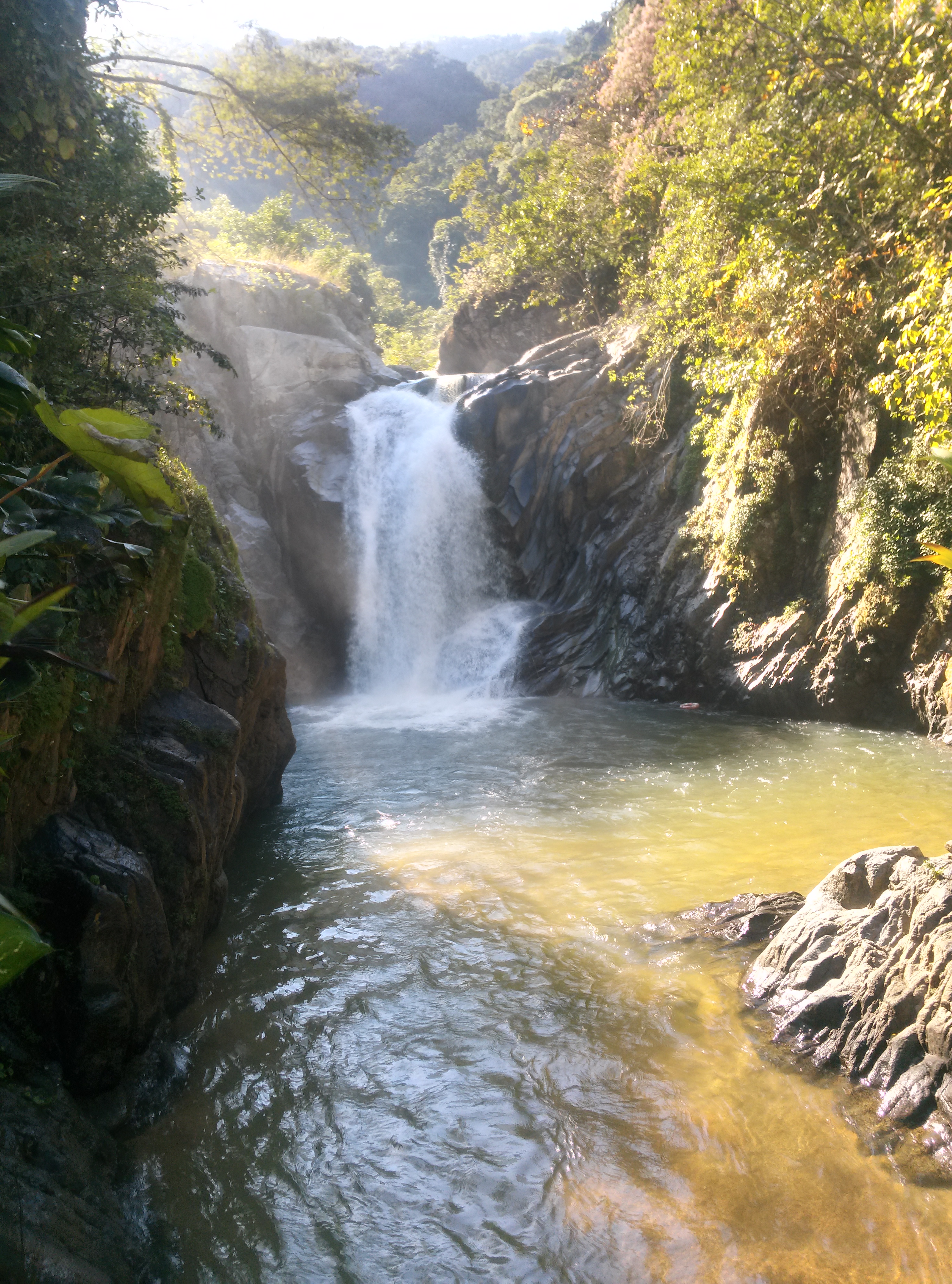
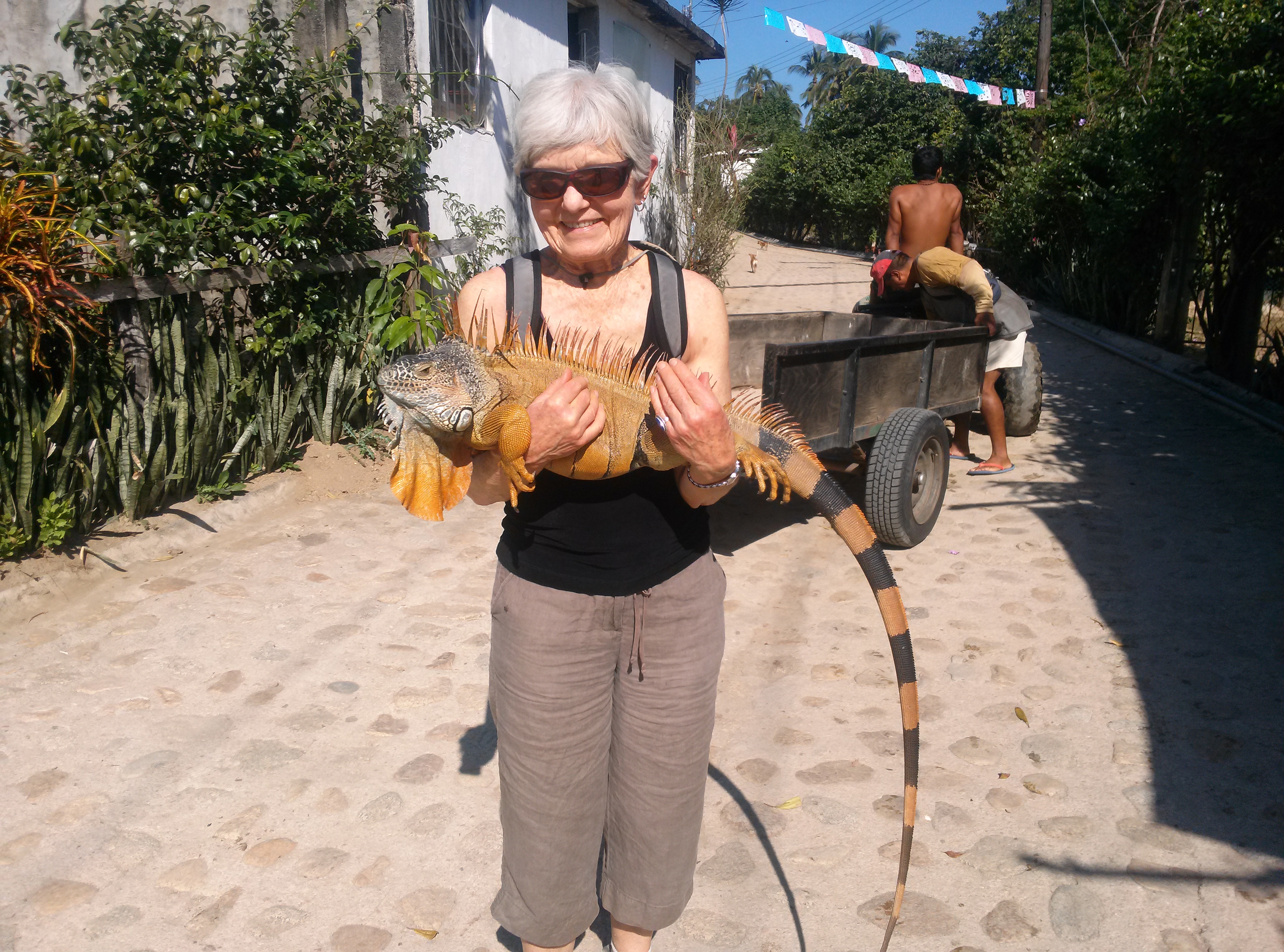
Vallarta Adventures brings a boatload of tourists from the cruise ships in to Quimixto and takes the people walking through town to a corral where 20+ Mexican ponies wait. Once the tourists are saddled up and instructed, they file up a trail to a dramatic waterfall about a mile and a half up into the jungle. I decided to walk this and had to cross the “creek” four more times, climb quite a bit to a bar perched on the edge of a deep pool into which the waterfall plunged. The tourists arrived by horse back after I had my viewing spot picked out, a good place to watch them jump in the water, haul the brave ones up hand over hand to a ledge and shoot down the water fall’s natural sluice. Enterprising locals had souvenirs for sale and one man offered me a giant iguana for a picture. And a tip, of course.
Waterfall above QuimixtoIguana photo op
Pier and harbor in Quimixto
In the other direction from the village, a trail ran along the shore and then climbed to a long undulating ledge to another cove and another village, this one much larger though still accessible only by boat. Perched on this trail’s hillside amidst the jungle plants is a yoga center, sleeping cottages stair step up to the main yoga room at the top. The place is only 3 years old. http://www.xinalaniretreat.com/ Check it out. I walked the trail below the center, across their beach and up into the jungle towards Las Animas beach, about two miles along the coast. Believe me; I will take my hiking sticks with me in my suitcase every time I travel from now on. This trail was steep and rugged, rising and falling to streamlets.
Besides describing the wonders of this place, I want you to understand that my s-in-l suffers from neuropathy caused by complication that developed after a knee surgery. For two years now she has had a hard time walking, going numb in her foot and lower leg and the other knee is bone on bone. But, she is determined to continue adventures and will not sit down in resignation.
At the Grande Luxxe, Polly, Liz, Joan and I used the golf carts and trolleys to get from place to place on the vast campus, and walked miles to the beach, restaurants, the Santuario nightclub and to take taxis off on adventures. With careful on line research, I was able to locate an accessible restaurant right in the middle of the art galleries. We spent time admiring the art and talking to the artists, taking advantage of the weekly Wednesday art walk. The restaurant, if you are looking for fine cuisine and atmosphere, is Café de Artistas. The violin and piano duo rank right up there with the finest musicians and have a unique electronically connected way of playing together without occupying the same space. Hence, the violinist could wander throughout the many spaces and you heard them as if they were playing in the same room.
Walking to the main street that runs the length of the center of Puerto Vallarta, we watched several groups of Peregrinantes making their pilgrimage to the Church of Our Lady of Guadalupe. Typically, the groups come from parishes in the area, businesses, hotels and schools. They choose their theme which could be a float with a Virgin surrounded by the Bishop and Juan Pedro, the Indian whose miraculous vision of the Virgin is celebrated for twelve days. Other themes are dancers, flute, and drum players in Aztec costumes. We happened to be on the street corner when a motorcycle club roared to a standstill and waited their turn to process toward the church. Each group enters the church when their turn comes, brings their offering to the Virgin, receives a blessing and then disperses to the central square or along the streets where food booths invite with local delicacies: roasted ears of corn, flat bread, cups filled with cut melon and pineapple, freshly made tortillas, enchiladas, and so on. It is a logistical nightmare for some organizer and seems to work. Every group has its moment in church beginning at six and going until midnight. A Bishop is there at midnight on the 12th, the actual Saint’s day.
On Sunday, we attended the 10 o’clock mass which was in English and Spanish. The nave was packed with ex-pats and there were a few missals in English for the people who got their early. A visiting choir sang magnificently. We looked at each other with tears in our eyes, the music was so beautiful. Most churches in PV have no choir so this was a special treat. Talking with the soprano who sang the Ave Maria, (we met her at Starbuck’s after church); we found out that she grew up in the States singing in girls’ choirs. She got her first job after college in the American School in PV teaching the kindergarteners and immediately searched for a choir. She finally located one in the Iglesia del Refugio. It was their choir who so inspired us. I’ll know where to attend mass the next time I am in Puerto Vallarta.
Another brave adventure was a trip to the spectacular botanical gardens
brainchild of a group of ex-pats. Several years ago, they bought an
old ranch, and its Hacienda de Oro is authentic Mexican residence, now restaurant set above the Rio Los Horcones. Birds and butterflies abound. They just opened a new Conservatory of Mexican orchids housing a collection of orchids from many regions of Mexico, some very rare. This was my third visit. I have hiked the trails through the jungle and gone skinny-dipping in the beautiful river, but this time stayed close to the orchids, Hacienda and other plantings.
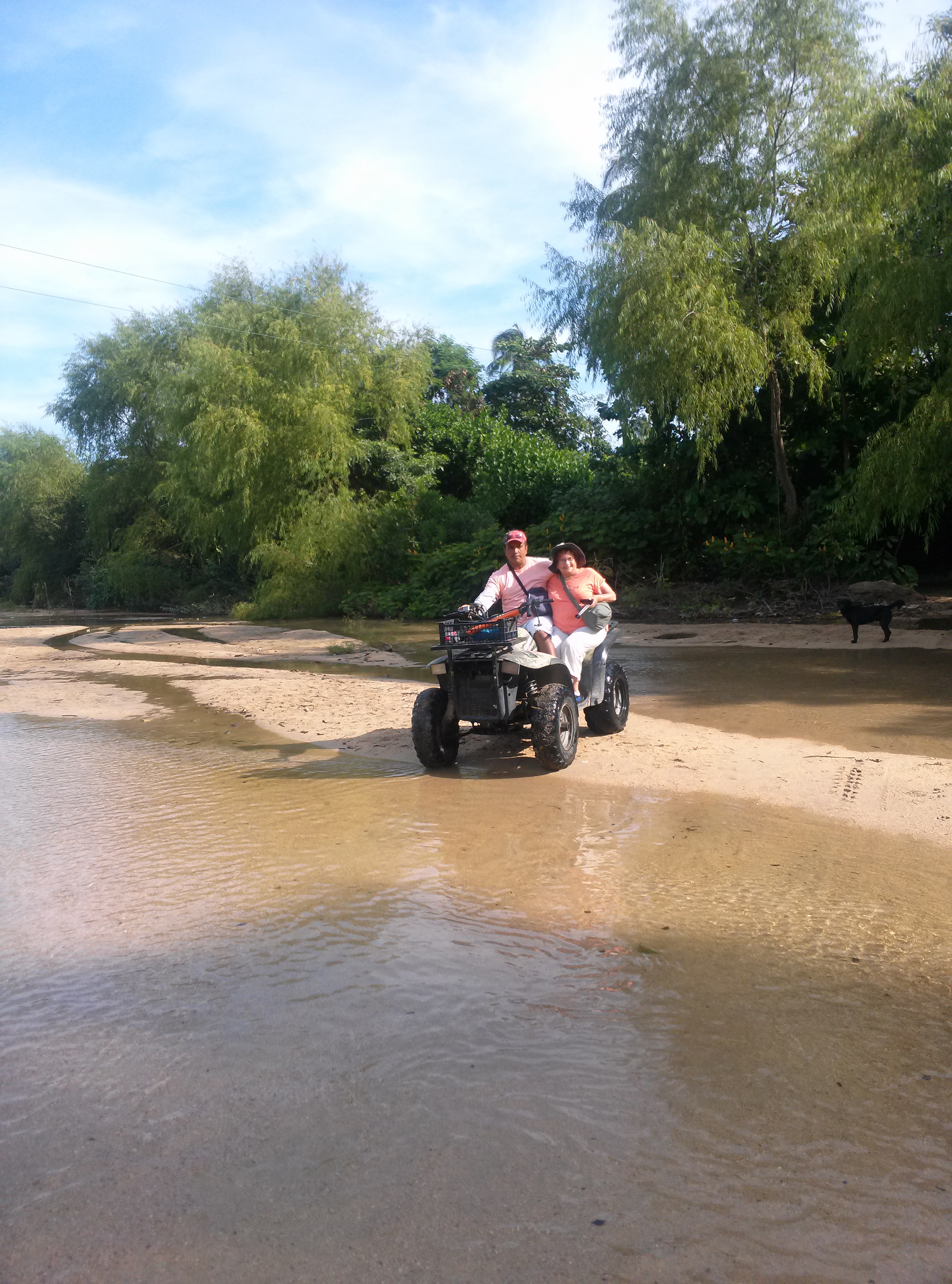
Returning to Puerto Vallarta is when the adventure began. We decided to take the bus, which meant getting from the Hacienda to the highway, an uphill cobblestone drive of 200 yards, more than either a walker or a pair of hiking sticks could manage. A gardener offered to take my companions on his ARV. What a sight! Unfortunately, climbing on was almost too much for bum knees, but we all survived, managed to board the bus and ride to the center of Puerto Vallarta. Whew!
The buses run on Basilio Badillo Street which is full of art galleries, a large blown glass sales room which specializes in exports, and an oasis restaurant owned by a Canadian. We went in there and had the best, most refreshing sangria I have ever been served. A great ending to a glorious adventure and everyone feeling all their limbs, joints and bones still functional. Pretty amazing.
In conclusion, I will say that the best adventure is the one you are determined to take, regardless of your challenges, walker, sticks and all. Attitude makes the difference. These ladies were brave and resilient even when the circumstances were difficult. If you can, go, and don’t let chronic disabilities hold you back. Next year you may not be able to go.
I sit here the night before Thanksgiving with multiple layers on, my nose cold and the backs of my ears feeling the cool air circulating in my living room, the temperature set at 65. The Roman shades are still up so I can enjoy the spectacular Christmas lighting I put up this year. The May pole is planted in the middle of the seven-circuit labyrinth that fills my front garden and hanging from its 15-foot tip are fourteen strands of multicolored LED lights. I am so proud of this accomplishment. It took several hours of mathematical figuring with the help of Google to find the circumference of a circle where the radius is 4 ft; and to determine the length of the hypotenuse of a triangle where the pole stands 15 ft. tall. I loved geometry but remember nothing. The three lengths of lights measured 66 ft each and, stretched end to end, I wanted them to hang in equal lengths with traveling distance between them around the edge of the circle on the ground. It was complicated. This seventy-seven year old brain figured it out and when the taped strands of lights rose skyward, their 14 lengths reached the ground evenly spaced around the pole. Must be the MindWorks at work.
These days leading up to Thanksgiving and the holidays are full of all the emotion that comes with a long to-do list and the hangover from holidays past. Yet somehow this year the Christmas letter is written and printed and ready for my grandson Jack to help me mail on Saturday. The special gift list for the holidays is updated and ready on my website. The version of the letter for family and friends not in my Shaklee family is printed and ready for mailing and labels for both sets are printed, stamps purchased and all will be done Saturday, using up the Christmas cards and envelopes I have stored over the years.
I have the Christmas event planned for the grandchildren: we will meet at the Experience Music Project for lunch and an afternoon of touring the exhibits, virtual music performing and good times at the Seattle center, maybe including a carousel ride. Why not? You never get too old for that. Even if these children are late middle school, high school and college aged.
Today I hiked with two stalwart friends who are as reluctant to give up the weekly wilderness as I am. It was a trip up the backside of Cougar Mt., one of the Issaquah Alps, near foothills of the jagged Cascade Range, a second growth forest of Douglas Fir, Western Hemlock and Red Cedar with big leaf maple and alder and plenty of thick sword fern and salal on the forest floor. The trails, developed over the years, are now maintained by the Greenway Mountain to Sound organization with the help of the Washington Trails organization. The hiker heading for Shy Bear Pass climbs to dramatic cliffs and past giant erratics (those mammoth boulders spewed around the region by the tumultuous volcanic and glacial periods eons ago).
My body keeps going and is getting stronger all the time, thanks to the guys at the Xgym. I feel lucky today. My cousin, Jack Bell, seven years my junior and far more diligent about his fitness than I, suffered a massive heart attack a week ago last Friday. He was in the gym at the time and experts performed CPR immediately. Ten days later, he is in a rehab facility near San Francisco where they will provide 5-7 hours a day of physical therapy to bring his fitness level back. This is the man who climbed Rainier for the Breast Cancer Fund and inspired me to climb Mt. Shasta a year later. He greeted me at the end of my climb with a silk prayer scarf from Tibet where he and his husband had gone. I greeted him at the end of his Rainier attempt with a big glass of Physique. It was a high wind, socked in, fog impeded ascent and he was in bad need of an after workout restoration. He has been up Kilimanjaro, Whitney and Aconcagua in Argentina, and others I have forgotten. He will climb mountains again.
Jack’s dad died of a heart attack. Jack will not die from this one. He has taken Shaklee vitamins for a long time. They probably help. His mother died of Alzheimer’s. He has been taking Vitalizer Gold and recently added MindWorks. This is a man who believes in prevention and the heart attack strikes him anyway. He will probably have a complete recovery because of those thoughtful and persistent prevention efforts.
We will all die. We do have some measure of influence on how and how soon.
I am off to my time-share in Mexico with my sister-in-law and two friends in their early 80s. The four of us will have a great time in the warm sweet smelling air, the fine-grained sand, the elegant accommodations and entertaining nightlife of the Gran Mayan Resort. We will shop for exquisite jewelry in the market and eat fish, guacamole (made fresh by me daily) and drink margaritas.
The deeply religious festival of the Virgin de Guadalupe will be our pre-Christmas advent preparation. Early December is a lovely time to be in Puerto Vallarta where Guadalupe is the patron saint. I have counted out my Shaklee supplements, my individual portions of Vivix, my 180 Smoothee mixtures for breakfast every day. I’ll be ready for whatever.
So much to be thankful for. Good health, good friends, loving family. I bid your prayers for all who struggle during this season when the airwaves perpetuate jollity and if you are not participating, you feel wrong somehow.
This is the time of the year when you will really want to add alfalfa to your supplement regime that is, only if you haven’t already experienced all the rich benefits of this fabulous plant. Seasonal changes in the weather often bring about sensitivities to various forms of pollen, mold and dust. So let’s see how Alfalfa plays a part in relieving allergy symptoms.
So here’s what we know about Alfalfa. It is one of nature’s richest sources of total food minerals and trace elements. Its many health-giving aspects have beneficial benefits for eyes, teeth and strong digestive systems, and connective tissues. Alfalfa roots burrow 20 feet into the ground to find precious trace minerals which when absorbed by the plant are stored in the leaves, stems and branches making it a veritable treasure of health giving nutrients. It is the richest land grown source of sub-nutritional trace minerals; combined with chlorophyll and other organic salts that give greater effect and power of generation to tissues. The word Alfalfa means father of all foods, and one of nature’s oldest legumes.
Alfalfa is a legume that has a long history of dietary and medicinal uses. A small number of animal and preliminary human studies report that alfalfa supplements may lower blood levels of cholesterol and glucose. Now there are many factors that make this product outstanding. Alfalfa contains quantities of:
Vitamins A, E, K, B, D & U,
Fiber, protein, and fat soluble,
13 separate minerals and additional trace minerals,
Contains 8 essential enzymes for digestion of proteins, fats, starches and sugars.
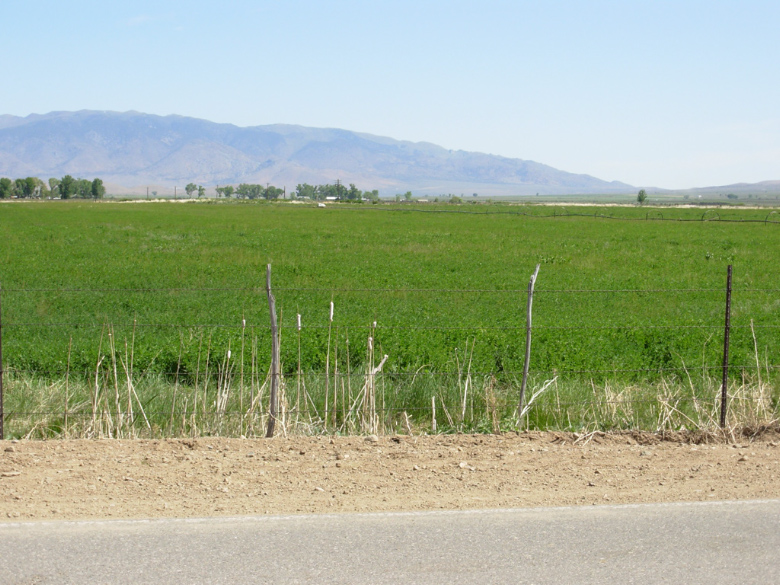
Shaklee Alfalfa is grown in the Antelope Valley without herbicides pesticides or organic fertilizers. This alfalfa is harvested at dawn when the leaves have the highest nitrogen and chlorophyll content. The cuttings are dried in the open air, the natural old fashioned way, and once dried, the alfalfa is ready to be milled and the leaf is separated from the desirable stem. The end product is a fine, green colored alfalfa “flour” which then goes though the tableting process.
Alfalfa complex is a Shaklee Signature Formula originally developed by Dr. Shaklee.
So now that know we have this fabulous natural product, what benefits might we experience. The list is endless but we will cover a few………
A great aid in digestion,
Aids in peptic ulcers,
Great diuretic and bowel regulator,
Effective barrier against bacterial invasion,
Anti- inflammatory, anti-histamine.
Natural body deodorizer,
Helps support the natural ph of the blood and much more.
Just remember that Alfalfa is known as a complete food. Now this may surprise you,
Some of the other properties that alfalfa has: An outstanding 18.9% protein as compared to beef 16.5%; milk 3.3% and eggs 13.1%. Isn’t that amazing!! Remember muscles are composed of protein and the lack of it causes them to break down resulting in fatigue and weakness.
In summary: If you want a general all around food supplement to support your many daily needs you will definitely want to consider Alfalfa and its broad spectrum of nutrients. And with that being said, you can now appreciate why Alfalfa is called the father of all foods.
Side note: Now I know that some of you are wondering what is vitamin U, so let’s satisfy your curiosity! Vitamin U plays an important role in maintaining health, vitality and well-being. Targets Acid Reflux and inflamed Gastro Intestinal lining instantly on contact. And one last surprising piece of information: did you know that each serving provides 300 mg of calcium about as much as in a glass of milk! You can now see why Alfalfa is considered a complete food and by the way, Scripture calls Alfalfa King of the vegetable family.
*These statements have not been evaluated by the Food and Drug Administration.
These products are not intended to diagnose, treat, cure, or prevent any disease.
Traveling again, and wanted so much to have a healthy retreat. I flew to Santa Fe for a long weekend to sit, walk and write with Natalie Goldberg at the Upaya Zen Center. November in Santa Fe worried me. I packed long johns, silk undershirts, leg warmers and turtle necks and vests.
It did snow, their first of the winter, but I need not have worried about these Zen practitioners. They are not given to the kind of austerity we witnessed in the book Natalie assigned to us: The Bones of the Master, by George Crane. The page-turning tale of a Zen Monk, Tsung Tsai, was the last and only member of his Ch’an lineage in Inner Mongolia to survive the Red Chinese take over. Under normal circumstances these monks endured freezing temperatures without heat or warm clothes.
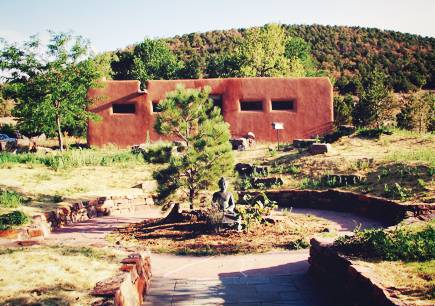
Upaya was toasty from the spacious Zendo where the sixty-seven participants met for writing to the sleeping quarters scattered in older and new southwestern adobe style buildings on the Center’s campus.
Health issues came up over and over as a topic in writing practice. Natalie is battling cancer and was not with us for every meal or for the early morning sitting zazen, harboring her strength. When I saw her the first day, I was relieved to the point of tears to see light in her eyes and no strained evidence of pain clouding her mind and wit and demanding teaching.
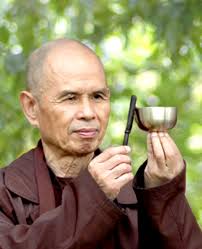
Thich Nhat Than, the Vietnamese Zen bhuddist who has offered so much peace making teaching to us Americans over the last 45 years and has been a spiritual guide for many, is lying in an ICU with a cerebral hemorrhage.
While walking in a nearby Nature Conservancy reserve east of the Center, I received notice of my cousin by marriage, Jack Bell’s massive heart attack. Mortality loomed large. The Roshi (the abbot or head priest of a Zen center), organized a healing service for all who hang in that liminal place between life and death asking for best possible outcome. Roshi Joan Halifax spoke to us about not knowing what the “best” is. The names of those close to the Center who have gone on to join the Great Majority were listed on the altar. I was profoundly moved by the service, the chanting, the deep surrender to the will of God.
We students wrote our hearts out and read aloud to each other. I was struck by how often struggle and death came up. These big themes were peppered by the lesser but just as pesky themes of life threatening aches and pains of the aging body. Even the younger writers read about waking up to the changes they notice in their bodies, the laziness that has taken over, the hurry of life that causes neglect of physical health. Natalie has always taught “Sit, Walk Write” and paid additional attention to long vigorous walks as a way to loosen the mind and go deeper. I overheard comments like, “I’m going to put more walking into my day.” “I’m going to be more consistent with my exercise.”
One woman I wrote with at a writing retreat in Italy is swimming again, up to a mile as she turns 69, using the thirty-five laps as intentional meditation time.
You think of writing as a sedentary life, but the way Natalie teaches it, it is anything but. When you are stuck and have become too linear or wallow too long in research, get up and walk: around the house, the coffee shop, the neighborhood.
The sitting part of practice is the hardest on the body. At the Upaya Center, they begin at 6:30 a.m. and sit on their cushions in silence for 40 minutes, take ten minutes of slow walking and stretching and then 40 more minutes of silent sitting. I joined each morning at the slow walking part and at first sat in the folding chairs provided. I was awake in time for the 6:30 sit time, but staying healthy on the go requires me to lie on the floor and do my back exercises, cat/cow stretches on all fours and a few yoga moves so I am functional with relatively little pain all day. The second two days, I sat on a cushion and fared pretty well with the hips and knees.
When I travel, I take a small camping pillow for my head and another to put between my knees while sleeping. Something you might try is finding a pillow that keeps your back and neck lined up in a back-friendly way.
I always take all my supplements. The stress of travel is no time to cut back on the nutritional support you are accustomed to at home. One of Natalie’s writing topics for a “bullet writing” –2-3 minutes—was “Vitamins.” One writer, a nurse from Phoenix who I roomed with when I went to write with Natalie in France, was saying she was so confused by vitamins and took the ones everyone talks about—Calcium, D and fish oil—but never felt any difference. So she wandered away from that discipline. I suggested a good multi might make everything work better.
What I love about the Shaklee Corporation is that they tell you up front if you don’t feel better with Vita-lea and Protein taken daily for one month, you will get your money back. That’s a big promise and seldom cashed in on.
Water, water, water when you travel. The high desert of Santa Fe, 7000 ft.—gave me a slight headache and dizziness. After 24 hours and quarts of water, everything was fine. I know some people slow down on their water intake when they travel because they are worried about the availability of bathrooms. Trust the place. Drink water. You will feel better.
On the way home I had a twinge of throat tickle and plopped a Vitalizing Immunity in my water bottle and drank it down before boarding the plane. Gone. No hint of a cold.
I had my Herb lax in case the food and water—being different—caused digestive difficulties. In fact, the cook, Sharon, at the Upaya center is creative with seasonal root vegetables and prepared the most delicious and nourishing vegetarian meals I have ever eaten. Lots of roughage!
Whether you are traveling for business, pleasure, study or a healthy retreat, take care of yourself. Keep your immune system strong so you don’t get sick. That can ruin a trip. Stay hydrated and keep the digestive track functioning.
Don’t forget sleep: I always take ear plugs and Gentle Sleep Complex to help with sleeping in a strange place. How wonderful to attend a healthy retreat!
I love hearing what you do to stay healthy on trips. Please comment.
Do you wonder if we approach our health from the point of view of fear? Fear-based medicine seems to trump science. We are afraid of cancer, of sexual dysfunction, of diabetes, of heart disease, of arthritis and of Alzheimer’s or memory loss. I was just with a group of people last night when the person speaking forgot a name and a look of panic clouded his face. Everyone—all over 45–chorused “aging problem”. We all know someone whose spouse or parent “isn’t there” any more.
TV show and books write about common health practices such as fluoridating city water and vaccinating children and using Mercury in dental fillings as extremely dangerous and health threatening. Dr. Sears is one such author. Dr. Sardi’s radio talk show about the dangers of certain medical diagnoses and treatments is another. You can find a pundit to support any fear-based health question you may have. How are we to navigate all this intensity around health?
I tend to live in both camps, seeing my doctor for blood tests and other annual markers to help me decide what actions to take about osteoporosis, skin cancer possibilities, blood sugar, cholesterol and fat levels. I rarely take his advice about prescriptions that might help, but rather go to the alternative health and prevention side of the house for my next steps. I have to admit that given my family history, I get frightened when a pre-cancerous spot shows up in my scalp or on my face. I leave my annual physical triumphant when my blood tests reveal that taking the Shaklee Cholesterol Reduction Complex has lowered my cholesterol 17 points in one year.
Do supplement manufacturer’s research and produce new products in answer to fear based medicine? Do the Shaklee scientists study fearful health issues in order to fix the problem? In order to give us relief from our anxiety? Do I take all the supplements I take because I am afraid of ill health, of losing my agility, my thinking capacity, my resistance to developing cancer? Is supplementation part of fear-based medicine? I do not trust myself to eat a balanced, nutrient rich diet every meal of every day. I don’t trust the food I buy and cook to nourish me enough to prevent the diseases I am afraid of. To counter this fear, I take supplements I believe are organically sourced and designed to reach my cells.
Perhaps good health has become a religion, an answer to fear about the future. I just watched a few episodes of Dr. Phil, the TV host who is going to be talking about Shaklee’s new MindWorks on Nov. 17. The shows I watched portray him as intervening in people and family’s dysfunctional lives. I am curious as to how he will engage the 5 yrs of research Shaklee’s scientists have done to produce and test MindWorks. Will MindWorks be a life changer in the psychological realm? Tune in with me to find out. Monday, November 17th.
I watched a few episodes of Dr. Oz, whose latest emphasis is on rapid weight loss. He has identified a number of foods that he believes are causing people to gain and retain extra pounds, foods that were extremely challenging for the successful “losers” to stop consuming in the first few days of their rapid weight loss diet. I would be interested to know if those dietary changes will be permanent. If they are, those dieters will lead healthy lives.
Just do a web search for health and wellness shows and you will find a channel devoted to the topic, the Discovery channel’s Health and Fitness program, and the announcement of three new healthy living channels. This latest addition claims to put our fascination with food into healthy actions which will make us healthier. We are all fascinated by our own health. There is money to be made marketing to this fascination.
Roger Barnet bought Shaklee to do well by doing good. Roger is an idealistic wealthy entrepreneur from New York City who bought Shaklee in 2004. His dream is to earn the Nobel Peace prize as the first business to satisfy the criteria of the committee. He does not seem to be motivated by fear, but by a desire to improve the health of poor people. The idea is that healthy people may be less desperate, less likely to fight for survival. He has not put that in writing anywhere that I have seen, but I’ve heard him talk about his vision of a world populated by healthy people being a peaceful world.
What is your motivation for eating the way you eat, or supplementing your diet, or working out? Are you at peace with the fact that no matter how much we work to ward off disease, something will take us down in the end? Unless we suffer accidental death, that is. We are trying to improve our health span to match our life span, hopefully not out of fear-based medicine—panic, but through making better choices every time we eat and move. I would be interested in your comments. Please share. If you are not on my blog list, sign up for the weekly post at the bottom of this page.
Be well, Do well and Keep Moving, out of joy, not fear.
Cold and Flu Season= Immunity and how to get more of it.
Organs of Immunity
Skin: Forms an effective barrier against pathogens.
Respiratory system: Cilia lining the airway move mucus and contaminants out of the body.
Stomach and intestines: Stomach acid kills most bacteria. Antibodies secreted by the intestinal cells attack pathogens.
Lymph nodes: Lymphocytes are cells of the immune system that recognize and eliminate pathogens.
Spleen: Aids the body in fighting harmful bacteria.
White blood cells: Attachs pathogens throughout the body.
How Viruses Work
If you have ever had a cold or the flu, you have been the victim of a virus. “Viruses are responsible for many other serious, often deadly, diseases including AIDS, Ebola, infectious hepatitis and herpes.”
Viruses are tiny microbes much smaller and very different from bacteria in that they cannot survive on their own. Viruses need to invade a living cell in order to live and grow. Once inside a host cell, viruses rapidly replicate themselves, burst their host cell and start infecting other cells around them. Once enough cells are effected, you begin experiencing symptoms such as fever, cough and sweating as the body tries to defend itself against the attack.
Why viruses are so difficult to combat…When the proper host is not available, some viruses can hide out in your body for years waiting for the right conditions. Viruses can mutate quickly so as soon as scientists create a new vaccine, a mutated resistant virus often appears. An antibiotic doesn’t necessary help unless the bacteria is identified and the medication is specifically designed to kill that strain of bacteria.
How viruses spread…Most viruses are airborne and can pass from an infected person when they cough or sneeze. Others are infectious only when a person has contact with the bodily fluids of an infected person…like the AIDS virus. Some viruses are tough enough to live on room temperature surfaces (doorknobs, handrails or countertops) for up to 48 hours. That’s why frequent hand washing is critical if you want to avoid viral infections.
Bulletproof immunity…Recently, a devastating strain of Enterovirus has been infecting school-age children, developing overnight from mild flu-like symptoms to threatening their very ability to breathe, particularly in children with asthma. In a global community, we are exposed to widespread contagion of pathogens, many of which have no preventative vaccine or medical treatment.
Our best defense is a strong immune system.
Strong immune support is no guarantee, but it is your best chance to stay healthy in the face of any and all health threats.
5 steps to bulletproof your immunity:
Stay hydrated. Healthy fluids such as Get Clean Water and Shaklee tea flush toxins.
Eliminate Sugar refined sugar is a poison which dramatically decreases immune function.
Get enough sleep. Lack of sleep depressed the immune system. Try Gentle Sleep Complex.
Eat healthy foods often. Plenty of fresh vegetables and whole fruits, to keep your blood sugar even throughout the day.
Take probiotics. 80% of your immune system is located in your gut… trillions of beneficial bacteria help you fight disease and absorb nutrients. Optiflora
My knee complains. Knee pain from the old injury is caused by arthritis. In the forest searching for chanterelles, my companions and I climb steeply to the plateau, second growth northwest forest of red cedar, western hemlock, Douglas fir, alder and vine maple. The understory is mossy in places, the green blanket providing the perfect platform for the golden mushroom; in other places, it is thick with salal, sword fern and Oregon grape. Chanterelles hide there, too. This hunting ground is well known to local pothunters, the name we give people who hunt mushrooms for food, delicious sautéed-in-butter food. We did not have hope for finding many.
Glorious! On a super steep incline, there they were, pockets of gold, enough for all three of us. On the way down, my knee—the left one—complained bitterly. I traveled without my hiking sticks. They get in the way when hunting mushrooms. A couple times, I feared the knee pain would cause my leg to fail me completely.
In 1992, I avoided a long trek to get back to my car by climbing a chain link fence and jumping to the ground on the opposite side. My left leg suffered nerve damage when I herniated a disc—L5—in 1989, so it did not give or bounce when I landed. I heard the pop and knew I was in trouble. I managed to walk to my car, drove home, had a hearty snack and headed for the emergency room of the University hospital. Fast forward to the consultation after 3 months of non-weight bearing healing:
Mrs. Bell; Expect arthritis, probably severe, within the next couple of years and we’ll see you here for a knee replacement ten years from now.
That was twenty-two years ago. I have managed the arthritis with exercise and supplements and, until now, have had only a few twinges of knee pain and the sensation of the knee giving way very occasionally.
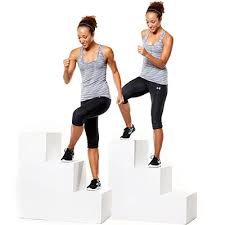
What to do? I have increased the stair climbing exercises, but not straight up and down. I suspect that the knee pain is the result of neglecting the best exercise for
Do the grape vine step up and down stairs to strengthen the knees
knees that I know about: the grape vine step up and down the stairs. I wish I had a video to show you. Point your shoulder to the top of the stairs. Facing the bottom step sideways, begin climbing by putting the outside foot upon the next step behind the inside foot; lift with the upper foot; step up with the inside food; swing the outside foot in front of the inside foot in front and lift the body; repeat. The second 20 steps face the top with the opposite side of the body. I repeated this five times today and will do 200 steps up and down several more times this week. I can tell the difference right away.
Why does this work? Women have broad hips and a wide pelvis. Most of us women have slightly knocked knees as the result of the wide pelvis. The strain on the kneecap, muscles and tendons above and below the knee is great. When you strengthen the sides of the knee, this strain is mitigated. I learned this from a guy I met climbing the monster staircase from Blaine St. to Lakeview on Capitol Hill—300 risers. He was on the stairs going up with the grape vine step to increase his balance so he would be able to navigate backpacking in the high mountains with a heavy pack without as much danger of falling. I was training to climb Mt. Shasta, a 14,000 ft peak in northern California and immediately adopted his training method. I am back at it.
The confirmation of this training method came from an article in Seattle Women, “Training Like a Girl,” featuring Dr. Stan Herring, sports medicine doctor who works with University of Washington athletes and, was my doctor after my herniated disc incident. Dr. Herring stresses that “female athletes will obtain strength gains and aeroic gains in the same proportion as male athletes, if you train them appropriately.”
One major issue female athletes [all women who are active] face is their increased risk of anterior cruciate ligament (ACL) injury. “Females should spend more time with upper body strengthening and they should certainly spend more time with lower body conditioning for core and lower extremity strength, balance and motor control because it does have a direct effect on the ACL” says Dr. Herring. Let me share the information about the ACL which I found helped me understand why we women have more trouble with our knees.
The ACL is one of a pair of ligaments in the center of the knee joint that stabilizes the knee from front to back during normal and athletic activities. Increased estrogen production during puberty causes the pelvis to widen, which can cause the knees to turn inward. These hormonal and anatomical facts lead to female athletes sustaining noncontact ACL injuries between two and 10 times more often than male athletes. To avoid this risk, build up the secondary muscles that support the hips, knees and ankles. The stair climbing sideways with the grapevine step helps this. The author
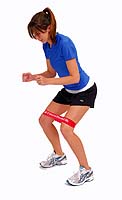
walk sideways with band around your legs above the knee
described strengthening the knees by tying an elastic band around you thighs or ankles—your feet are about 4 inches apart when you are setting this up—and then walking around the house in a squat position, moving sideways and another set moving forward. This strengthens both knees and legs. Do about 40 to 60 steps sideways in one direction and then reverse, leading with the opposite foot for 40 to 60 steps. Maintain the squat position throughout.
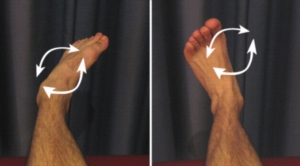
Above all, when confronted with joint pain, do not sit down and avoid using those joints. Find something you can still do. Joints have low blood flow. They need movement to stay functional. Of course, if you have a major inflammation, you need to reduce that with medication, ice and rest, but test yourself for the best way to get movement back into that joint. When I was non-weight bearing for so many weeks, I sat on the floor and lifted the affected leg, traced the alphabet with my foot, isometrically tensed and relaxed the muscles up and down the leg, did side lifts with the affected leg. When the cast came off, I walked without a limp. The muscles had not atrophied. I know people whose knee replacement surgery or other foot and leg surgeries have not healed well. More movement to stimulate blood flood would surly help healing.
I am going to avoid knee surgery as long as I possibly can. Using sticks to climb and descend helps relieve pressure on the knees. I’ll keep you posted. Let me and my readers know what your techniques are to lessen knee pain and keep moving.
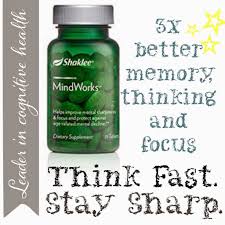
What is MindWorks™?
MindWorks contains key nutrients that have been shown in
three clinical studies and dozens of laboratory studies to improve
short-term mental sharpness and focus and help protect against
age-related mental decline.*
Scientific studies have shown the key ingredients in MindWorks
work in three ways:
• Immediate improvements in memory and focus*—3X better
than the control group**
• Protects against age-related mental decline*—a 30% reduction
in the rate of brain shrinkage, a common consequence of aging,
over two years‡
• Supports healthy circulation*—designed to help make key
nutrients available to the brain*
MindWorks is a revolutionary program that combines clinically
supported nutritional supplementation and brain-training
software to help your brain stay sharp and focused.*
What are the key ingredients in MindWorks?
MindWorks is an exclusive formula powered by the following
key ingredients:
Chardonnay grape seed extract—Only available to
Shaklee, MindWorks contains a unique Chardonnay grape
seed polyphenol blend created via a patent-pending water
extraction process that results in a 30X concentrate of specific
polyphenols.† These polyphenols have been shown in clinical
studies to be more bioavailable and impact healthy blood
vessel function.*
Guarana—We sourced a carefully selected guarana extract
that is prepared as described in several important clinical
studies of guarana—and our guarana extract has a naturally low
level of caffeine. Do not confuse our guarana extract with the
caffeine-spiked guaranas you may find in many energy drinks—
one serving of MindWorks contains less caffeine than a medium
cup of decaf coffee. Guarana has long been used traditionally by
Amazonian Indian tribes and has been shown to help improve
cognitive performance.*
B vitamins—The B vitamin combination in MindWorks was
shown to help protect against age-related mental decline in a
two-year clinical trial.‡
What is green coffee bean extract and why is it
used in MindWorks?
Research has identified specific polyphenols that have been
shown to protect neurons against oxidative stress, and influence
the levels of biochemical signals and growth factors that are
critical for the formation of new synapses. Green coffee bean
extract contains chlorogenic acid, a polyphenol, which has
been shown to provide this benefit. Green coffee bean extract is
less than 5% caffeine and does not make a significant caffeine
contribution to the MindWorks product.
Can I take more than 1 MindWorks tablet per day?
There is no known additional benefit in consuming more than
one tablet. In fact, the amounts of key nutrients in MindWorks
were chosen on the basis of their optimum response in clinical
trials and lab studies.
MindWorks
Think fast. stay sharp.
**At six hours versus control. †% by weight of monomeric flavanols compared to a fresh grape seed. ‡Based on a two-year study of 223 adults with mild cognitive impairment.
*These statements have not been evaluated by the Food and Drug Administration. This product is not intended to diagnose, treat, cure, or prevent any disease.
Would you like to do a one month trial of MindWorks and see what your results are? Shop at www.HiHoHealth.com. I noticed a difference in short term memory. You know, wondering why I went to the basement? I remembered, even though I was distracted by several others things along the way. What will you notice?



![CAM02072[1]](http://www.grandmabetsybell.com/wp-content/uploads/2014/12/CAM020721.jpg)
![CAM02086[1]](http://www.grandmabetsybell.com/wp-content/uploads/2014/12/CAM020861.jpg)
![CAM02026[1]](http://www.grandmabetsybell.com/wp-content/uploads/2014/11/CAM020261.jpg)
![labyrinthUpaya[1]](http://www.grandmabetsybell.com/wp-content/uploads/2014/11/labyrinthUpaya1.jpg)
![CAM01994[1]](http://www.grandmabetsybell.com/wp-content/uploads/2014/10/CAM019941.jpg)